
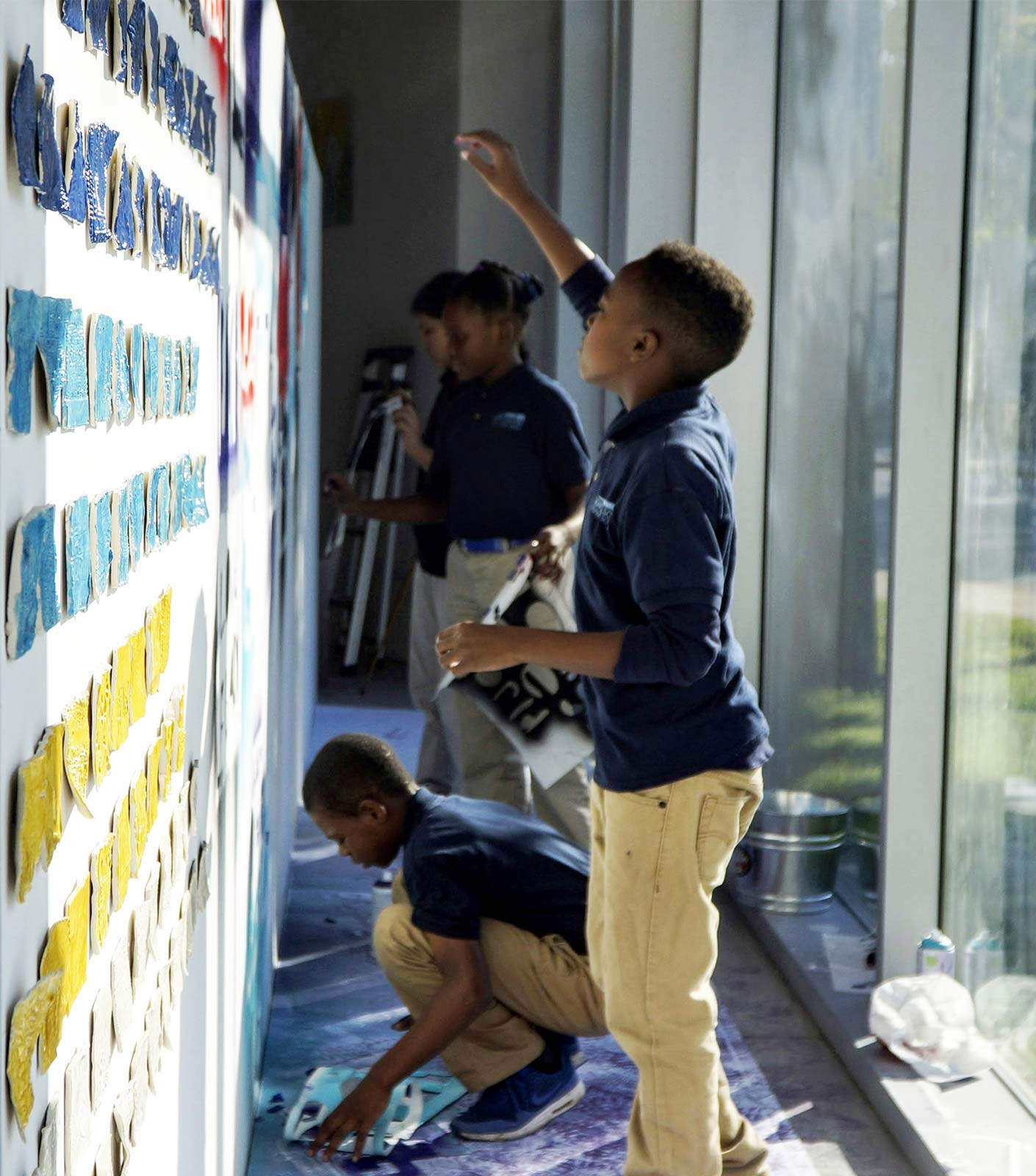

Our Children’s Museum of Art and Social Justice (CMASJ) is a critical piece of the arts programming at KIPP Chicago.
When KIPP Chicago’s regional support team moved into our current building in the Pilsen neighborhood, we envisioned it serving two purposes: providing office space for our team and housing the Children’s Museum of Art and Social Justice (CMASJ). The mission of the museum is to offer a space for the voices of KIPP Chicago students to be heard and to infuse a social justice curriculum into the arts at our eight schools. Our students range in age from 5-14 and the museum offers a space to showcase and celebrate their artistic explorations of social justice themes, inspiring action toward social change.
Our art exhibits are the result of students engaging in topics such as: the effects of gun violence, geopolitics and physical borders, the forgotten history of the origins of indigo dye, architecture and urban planning, water access and rights, the aesthetic theories and philosophies of Afrofuturism, activism, food justice, and more. With each new exhibit, curriculum is designed to bring age appropriate lessons to various art classes in our schools. Students are also part of offering tours to visitors and leading activity stations during opening nights.
Dedicated to the loving memory of James Foley, Rodolfo “Rudy” Avina, and to those who are voiceless to the social injustices of the world. CMASJ was established to act as a voice for the disenfranchised and to be a resource for arts programming and education. With the economic climate and increased budget cuts to the arts, the goal of the CMASJ is to relieve the impact the cuts will have on KIPP Chicago students by raising awareness and ensuring financial sustainability in order to provide arts programming.

Through the operations of the Children’s Museum of Art and Social Justice the opportunity to raise funds for art supplies and programming, while also putting emphasis on and addressing various social issues and social movements.
The mission of the museum is to offer a space for the voices of KIPP Chicago students to be heard and to infuse a social justice curriculum into the arts at our eight schools.
Our students range in age from 5-14 and the museum offers a space to showcase and celebrate their artistic explorations of social justice themes, inspiring action toward social change.
We are committed to pursuing more resources for arts programming and arts education in order to address the trauma that many in our city and country face. We are dedicated to the healing process that art inherently provides to support our community’s overall health and well-being.
We know that when students participate in the arts, they learn critical thinking, problem solving, and communication skills. When students have access to art education, they are engaging in thoughtful examinations of artwork and methods of art making in order to participate in critical, meaningful, and joyful learning. They are able to tell their story through art and appreciate the stories of others– encouraging empathy, peace, love, compassion, and unity. The CMASJ seeks to be a place to exhibit and celebrate this learning.
Admission is free for all ages. Donations are gladly accepted.
Monday – Friday | 9:00 AM to 4:00 PM
Saturday – Sunday | By appointment only
Every second Friday of the month
6:00 to 10:00 PM
2007 S. Halsted, Chicago, Illinois 60608
Located in the Pilsen Neighborhood on the southern border of the historic Chicago Arts District.
A one-hour tour includes a conversation around each art exhibit, a short video, and an activist button-making activity. We are a small, one-room museum inside the KIPP Chicago regional office, so we can only accommodate groups of 25 people or fewer. Students in grades K-12 are welcome! Email info@kippchicago.org to schedule a tour.